
2026 Ad Forecast: The Ad Economy Is Growing—But the Mix Is Quietly Re-Wiring Local Budgets
.png)
Read Time: 7 minutes
Why the next $56 billion in growth won’t land where it used to—and what local sellers and agencies should do about it.
The U.S. advertising and marketing economy is entering 2026 with a tailwind—and a warning label.
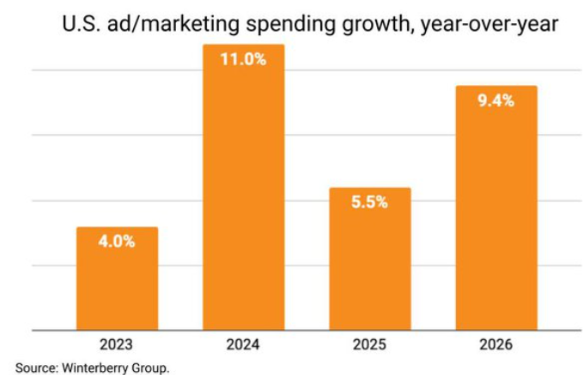
Winterberry Group, a growth consultancy specializing in the intersection of marketing, advertising, technology, data and analytics, projects total U.S. advertising, marketing, and related data spend will climb to $664.2 billion in 2026, up 9.4% from 2025, after a year that turned out stronger than even the forecasters expected.
That headline sounds like broad-based expansion. It isn’t. The more meaningful story is what’s under the growth: budgets are moving steadily away from traditional “reach media” into digital, data-driven channels, and the money behind the money—data infrastructure and AI—is becoming a larger part of the marketing stack.
For local media sellers and local-market agencies, 2026 won’t simply be “a good ad year.” It will be a year when advertisers continue to re-allocate spending to places where targeting, measurement, and optimization look easier to defend in a budget meeting—even if those benefits are sometimes more perceived than proven.
2025 surprised to the upside—and that matters for 2026 expectations
Winterberry notes it had projected the industry would reach $585 billion in 2025. Instead, it finished stronger, rising to $607.4 billion, helped by a better-than-expected second half.
Winterberry Executive Chairman Bruce Biegel described the conditions as unusually steady: moderate inflation, accelerating use of machine learning and AI, and macro stability that produced real growth after inflation.
That last part matters: when marketers feel the floor is stable, they experiment more. And experimentation is exactly what pushes money into newer formats and platforms—particularly CTV, social video, and performance-driven digital buying.
The “event year” lift: sports + politics add fuel
Winterberry expects the 2026 cycle to get an extra push from big moments that traditionally unlock incremental budgets: global sports and U.S. politics.
The firm points to increased spending tied to events like the World Cup, the Winter Olympics, and the U.S. midterm elections—with political spend expected to exceed $10 billion, lifting growth from 7.6% to 9.4%.
Local-market implication: event-driven dollars don’t just benefit national media. They also spill into local broadcast, local digital extensions, sponsorships, and direct mail—especially in competitive districts and swing states.
The real headline: digital keeps taking share
Winterberry’s data makes the long-running shift impossible to ignore: in 2022, online channels represented 56.4% of marketing spend; by 2025, that share reached 65.1%.
In plain terms: even when the overall pie grows, traditional channels can lose slices.
Winterberry reports that direct mail, linear TV, radio, print, and magazines each posted declines in 2025, roughly 3% versus the prior year.
Meanwhile, search, social, display, video, CTV, and digital out-of-home grew at least 5%, with overall online marketing up 11.1%.
For local sellers, this is the moment of truth: if your pitch is still structured like “here’s our reach, here’s our rate card,” you’re going to feel more friction—because advertisers increasingly want media that comes with proof, targeting, and attribution language they can bring back to management.
Why “video everywhere” is the new default
Winterberry expects video formats to drive engagement across linear, social, and connected TV.
That fits what local advertisers are already doing in the wild:
-
TV clients want CTV extensions and streaming placements
-
radio advertisers want video + short-form social to follow audio
-
newspapers and magazines are leaning into video storytelling and sponsored content
-
agencies are building more campaigns around “one message, many placements” rather than one big channel bet
The local takeaway: the more you can package your inventory as video-enabled, the more you match where budgets are heading—especially when advertisers can repurpose creative across multiple surfaces.
The money behind the money: data and AI spending becomes a line item
Another important part of Winterberry’s outlook isn’t the media itself—it’s the infrastructure supporting it.
The firm forecasts investment in AI and data-related marketing spending will reach about $30 billion.
And it projects marketing-related data, data services and infrastructure will grow 8.7% to $33 billion in 2026.
That’s not abstract. It shows up locally in the form of advertisers asking questions like:
-
“Can you target only homeowners who are likely to replace a roof?”
-
“Can we retarget site visitors with a different message?”
-
“Can you show me lift or store visits?”
-
“Can we build an audience once and reuse it across platforms?”
Which leads to a very practical sales reality:
The local seller who sounds like an analyst will increasingly outperform the local seller who sounds like a broadcaster.
Not because broadcasting doesn’t work—but because CMOs and local business owners are under pressure to justify decisions, and “data-backed” language travels well inside organizations.
Offline decline—except where politics and promotions bend the curve
Winterberry expects offline media to keep declining overall in 2026. But it flags two important exceptions: elections and certain categories of “activation” spending.
The firm notes elections can act as a catalyst for direct mail and linear TV to post gains this year.
It also expects shopper marketing and sponsorships to surge, helped by global sporting events.
This is a selling opportunity hiding in plain sight for local media and agencies:
-
Sponsorships are where you can defend premium pricing
-
Shopper programs are where advertisers want end-of-funnel proof
-
Event adjacency is where brands pay for being “part of the moment”
In many markets, the most resilient local dollars aren’t bought on CPM math alone. They’re bought because the advertiser wants to own something—a segment, a season, or a community connection.
Digital growth continues—led by CTV, social, video, and creators
Winterberry expects digital to grow 12% in 2026, led by CTV, social, video, and creator marketing.
This isn’t just a national trend. It’s becoming the local norm:
-
auto dealers increasingly want streaming video + retargeting + paid social
-
banks and credit unions want audience targeting rather than broad reach
-
healthcare wants compliance-safe, measurable digital plus local trust
-
retail wants promotional bursts that can be adjusted quickly
For agencies, the opportunity is obvious: the more complex the channel mix gets, the more valuable you become as the orchestrator.
For local media, the play is to sell not just inventory—but outcomes and audiences, bundled into campaigns clients can understand.
What local media sellers should do with this forecast
Winterberry’s report is the macro trendline. Your job is to turn it into local revenue.
Here are five practical moves.
1) Change your pitch from “media” to “decision safety”
Local advertisers aren’t just buying exposure. They’re buying the confidence that they won’t regret the check they write.
So your pitch becomes:
-
“Here’s who we reach” plus
-
“Here’s how we’ll measure progress” plus
-
“Here’s what we’ll optimize by week two”
2) Lead with video-first bundles
If video is driving engagement across linear, social, and CTV, package accordingly:
-
15s/30s CTV + pre-roll
-
short social video + paid distribution
-
sponsorship placements where video lives “above the fold”
3) Sell sponsorships like assets, not add-ons
When Winterberry says sponsorships will soar, it’s a reminder that advertisers still pay for status and association.
Build packages where the advertiser “owns the tent,” not just “gets a booth.”
4) Learn to speak “data infrastructure” without pretending you’re an engineer
You don’t need to be technical. You need to sound credible:
-
“We can build an audience and re-use it.”
-
“We’ll track response signals and adjust.”
-
“We’ll use sequential messaging so your story builds.”
5) Use 2026’s event calendar as a reason to book early
World Cup. Olympics. Elections. These trigger budget releases.
Your job is to connect them to local relevance:
-
“These events raise attention and media consumption—here’s how you win locally while everyone is watching.”
One more signal: consolidation is accelerating
Winterberry also points to marketing M A running near record levels, citing global mergers and acquisitions reaching $4.9 trillion in 2025, the second-highest year recorded.
For local agencies and media operators, consolidation matters because it changes:
-
vendor stacks
-
buying leverage
-
platform dependence
-
competition for talent
-
and the pace at which “best practices” become standardized
When the ecosystem consolidates, differentiation shifts from “having access” to “knowing what to do with access.”
The bottom line for local sellers and agencies
Winterberry’s forecast isn’t just that advertising is growing in 2026.
It’s that the growth is increasingly flowing to channels that feel measurable, targetable, and adaptable—especially CTV, social video, and data-driven marketing, with more dollars moving into AI and data infrastructure behind the scenes.
For local media salespeople, the job is no longer to defend why traditional media still works.
It’s to package local reach into modern buying logic: audiences, outcomes, proof, and optimization.
And for local agencies, the opportunity is to become the translator-in-chief—helping clients navigate a year where the ad economy grows, but the rules of allocation keep evolving.
The money is coming.
The winners will be the ones who know where it’s going—and how to sell it before it arrives.
Source: MediaPost.com
.png)
.png)
.png)