
.png)
When and How to use AI
Sales teams aren’t losing deals because they lack effort—they’re losing time to inconsistent prep, scattered follow-up, and vague positioning. This article outlines 10 proven AI prompts that help local media reps and agency professionals move faster on the work that actually drives revenue: discovery, conquest strategy, objection handling, proposals, and next steps. Each prompt is designed to produce clearer thinking and cleaner execution—so you sound more strategic, not more “salesy.” The result is a repeatable system that helps teams win more meetings, protect renewals, and build bigger, longer-term contracts.
.png)
Mastering Time: The Competitive Advantage for Local Media Sales and Agency Teams
Local media sales professionals and agency teams face rising operational pressures, making disciplined time management a critical competitive advantage in a fast moving advertising environment. By prioritizing tasks, implementing structured systems such as time blocking, and leveraging digital tools, professionals can convert daily chaos into predictable, high value workflow. A new force—client expectation inflation—has intensified the need for clearer boundaries, faster decision frameworks, and consistent communication rhythms. Those who master time not only improve personal productivity, but gain an edge in responsiveness, strategic insight, and long term client retention. close
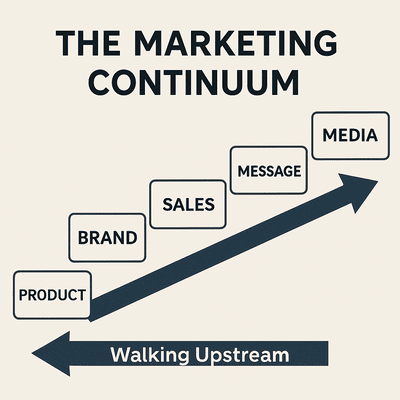
Understand The Client Continuum
Most media sellers show up to renewal meetings eager to talk schedules and impressions, while their clients are preoccupied with upstream issues like market share, competition, and sales performance. This article introduces the “Marketing Continuum” — Product, Brand, Sales, Message, Media — to explain why advertisers live upstream while radio and other media live at the far end. Because of this gap, many renewal conversations are misaligned, with sellers pushing media solutions while clients are still wrestling with deeper business questions. Sellers who deliberately “walk upstream” by asking thoughtful questions about the client’s current challenges shift the dialogue from “Do you need a Q1 schedule?” to “What are you trying to achieve right now?”. Over time, this upstream posture transforms them from vendors into trusted thought partners, earning earlier visibility into plans and larger, more strategic opportunities.


Why Smart Sellers Start With a Client Needs Analysis
For local media reps, sales managers, and agency pros, a disciplined Client Needs Analysis separates order-taking from consultative selling.
A disciplined Client Needs Analysis (CNA) turns a sales call from pitching into diagnosing—aligning every tactic with one clear business objective and a simple success metric. By mapping the customer, current funnel, decision path, and constraints up front, local media sellers and agencies cut guesswork, right-size budgets, and set renewal criteria before a dollar is spent. The process is practical: do the homework, ask targeted questions, define the KPI, establish instrumentation (tracking numbers, landing pages, promo codes), and close with a one-page brief and same-day recap. Avoid common traps—rushing to inventory, juggling too many KPIs, and ignoring capacity—and make CNA a team habit through inspection, role-play, and consistent post-call summaries. The payoff is faster deals, cleaner creative, measurable outcomes, and higher retention—because clients fund what they understand and can track.

Steve Jobs and the Discipline of Wonder: Lessons for Media Sellers
Steve Jobs fused craftsmanship and commerce, turning Apple into a culture-shaping brand through ruthless focus, taste as strategy, and storytelling that sold meaning before specs. Formed by a machinist father’s “back of the cabinet” ethic, Reed calligraphy, Zen simplicity, and partnership with Steve Wozniak, he built products—and narratives—that felt humane. Fired in 1985, he reinvented himself at NeXT and Pixar, then returned to save Apple by subtracting complexity, staging launches, and insisting on outcomes, even while his perfectionism and abrasiveness carried real costs. His private life—minimalist habits, walking meetings, family, music—underscored a philosophy of clarity and intention. For media sellers and agencies, the playbook is concrete: lead with a promise, reduce to essentials, rehearse obsessively, measure what matters, and “ship”—because trust and renewal are built on disciplined wonder.

Phil Knight’s Quiet Ferocity: What Nike’s Founder Can Teach Media Sellers And Ad Agency Professionals About Building a Market, a Brand—and a Life
Phil Knight built Nike by fusing product truth with narrative power—an introverted runner who learned from coach Bill Bowerman to obsess over small improvements, then turned them into big markets. Starting as a cash-starved distributor, he sold urgently under constraint, listened closely to athletes, and transformed customers into evangelists, culminating in athlete-driven storytelling and “Just Do It.” His strengths—resilience, talent-spotting, and disciplined risk—were shadowed by blind spots (conflict avoidance and early missteps on overseas labor), which he addressed by upgrading systems and standards. For media sellers and agencies, the playbook is clear: start where results are provable, make the calendar your co-seller, keep one simple message, and design measurement that proves lift. The deeper lesson is cultural—treat constraints as creative fuel and build a brand worthy of belief, one disciplined iteration at a time.

Melinda Emerson and the Blueprint for Entrepreneurial Resilience
Melinda Emerson, known as SmallBizLady, transformed personal adversity into a national platform for empowering entrepreneurs through education, strategy, and community. After her first business faltered during a high-risk pregnancy, she pivoted to create SmallBizLady, launching bestselling books, a weekly Twitter chat, and a digital university. Her influence spans Fortune 500 consulting, mentorship of thousands, and pioneering efforts to make small business education accessible and inclusive. Emerson’s leadership blends authenticity, empathy, and tactical brilliance, while her personal style and reflections on legacy add depth to her public persona. Her story is a blueprint for resilience, reinvention, and building businesses that serve both purpose and people.

Mary Wells Lawrence and the Art of Advertising as Theater
Mary Wells Lawrence, the first woman to found and lead a major advertising agency, revolutionized Madison Avenue by blending theatrical flair with emotional storytelling. Her agency, Wells Rich Greene, created iconic campaigns like “I ♥ NY ” and “Plop, plop, fizz, fizz,” turning brands into cultural touchstones. She believed advertising should feel like cinema—bold, visual, and deeply human—and used style as both strategy and statement. Despite facing industry sexism, health challenges, and the eventual closure of her agency, she remained a mentor, a visionary, and a relentless advocate for reinvention. Her legacy lives on in every ad that dares to be bold and every woman who dares to lead with both brilliance and elegance.

Sara Blakely: The Art of the Unseen Revolution
Sara Blakely, founder of Spanx, transformed a personal frustration with pantyhose into a billion-dollar brand by blending grit, humor, and outsider thinking. With no background in fashion or business, she taught herself patent law, pitched her product door-to-door, and earned Oprah’s endorsement, launching Spanx into national fame. Her success is rooted in empathy, authenticity, and a growth mindset that embraces failure as fuel. Blakely’s marketing strategy relied on storytelling over ad spend, and her leadership style fosters vulnerability, purpose, and resilience. Beyond business, she’s a philanthropist, adventurer, and prank-loving mom who believes joy and discomfort are both essential to growth.

Sophia Amoruso and the Rebellion That Built a Brand
Sophia Amoruso rose from a rebellious youth and eBay seller to build Nasty Gal, a fashion empire that redefined online retail and millennial branding. After facing bankruptcy and stepping away from her company, she transformed her setbacks into a cultural movement through Girlboss, empowering women with content, community, and candid storytelling. Her journey is marked by radical self-belief, vulnerability, and a refusal to be defined by failure. Amoruso’s influence helped shape the aesthetic and ethos of modern female entrepreneurship, blending authenticity, digital fluency, and emotional resilience. Today, she mentors founders, invests in startups, and continues to inspire through her creative rituals, reading habits, and unapologetic approach to reinvention.

Fred Smith: The Maverick Who Delivered the World
Fred Smith, founder of FedEx, turned a college paper into a global logistics powerhouse. After serving in the Marine Corps and earning multiple honors in Vietnam, Smith launched Federal Express in 1973 with a bold idea: overnight delivery via a hub-and-spoke model. Despite early financial struggles—including a legendary blackjack win to cover fuel costs—Smith’s vision and discipline helped FedEx become the first U.S. startup to reach $1 billion in revenue within a decade.
He pioneered real-time package tracking and built a culture rooted in service, accountability, and innovation. Smith’s leadership style, shaped by military experience, emphasized clarity and empowerment. Personally, he was a devoted father of ten, aviation enthusiast, and philanthropist, turning down a second offer to serve as Secretary of Defense to be with his daughter in her final days.
Smith’s legacy offers timeless lessons: trust your instincts, build scalable systems, lead with empathy, and stay mission-focused. His story is a blueprint for entrepreneurs and sales professionals aiming to deliver impact with purpose.

Keep Your Eye on the Ball: Why Media Must Refocus on the Advertiser
Media sales professionals must refocus their efforts on understanding the advertiser’s business rather than simply promoting their own multi-media offerings. While digital media has become ubiquitous and powerful, traditional media still plays a vital role in building trust, reach, and local relevance—and the two work best when used together. Tools like The Media Audit and Scarborough provide rich qualitative insights into consumer behavior and advertiser categories, helping media reps consult rather than just sell. The key to success lies in empathetically listening to advertisers, diagnosing their challenges, and crafting solutions that genuinely serve their goals. In a world full of shiny digital distractions, media reps must “keep their eye on the ball”—the advertiser—and build relationships rooted in strategy, not salesmanship.

Leadership Quotes
Looking for a quote to inspire your company, shift your team’s mindset, or bring clarity to your own leadership journey?
You’ve come to the right place—
Marketing Insights, where strategy meets soul.
Leadership isn’t about titles or control—it’s about service, empathy, and the quiet courage to lead by example. The best leaders don’t just rise; they lift others as they climb. They empower growth, inspire through action, and leave legacies not in accolades, but in the lives they’ve impacted.
This space highlights quotes that remind us:
✨ Leadership is measured not by authority, but by influence.
✨ Not by personal gain, but by collective growth.
✨ Not by being in charge, but by caring for those in your charge.

Ted Rogers: The Visionary Who Tuned Canada into the Future
How a Sickly Kid from Toronto Built a Media Empire and What Local Sales Pros Can Learn Today
Ted Rogers, born into hardship after the early death of his father, overcame health issues and financial setbacks to build one of Canada’s largest media and telecommunications empires. Starting with a struggling FM radio station, he bet on emerging technologies and turned Rogers Communications into a powerhouse spanning radio, TV, wireless, and sports. His success was driven by relentless work ethic, visionary thinking, and a willingness to take bold risks when others hesitated. Rogers believed in long-term relationships, customer value, and giving back—donating millions to education, healthcare, and civic causes. His story teaches media sales and ad professionals that resilience, innovation, and purpose-driven leadership are the keys to lasting success.