
.png)
AI Was Supposed to Save Time. Instead, It’s Expanding the Workday.
AI is delivering speed for local media reps and agency teams—but it’s also quietly raising expectations, widening job scope, and bleeding work into breaks and after-hours. The risk isn’t just burnout; it’s weaker judgment, lower-quality output, and clients overwhelmed by too many “options” instead of clear recommendations. The winning edge in 2026 won’t be who prompts best—it’ll be who builds smart guardrails so AI accelerates the work without consuming the people doing it.
.png)
YouTube AI Slop: An Opportunity for Local Media
YouTube’s growing “AI slop” problem is a flashing warning light for the entire attention economy: when synthetic content becomes infinite, audiences experience it as noise—and start seeking protection, not more videos. That shift creates a premium lane for local media, whose human verification, community accountability, and task-based utility (weather, traffic, breaking news) become differentiators algorithms can’t reliably replicate. For local media sellers, the opportunity is to productize “clean” environments—owned-and-operated destinations, curated streams, and sponsorships tied to verified, high-signal formats. For agencies and advertisers, the slop era strengthens the case for adjacency control, fewer-but-better placements, and plans that optimize attention quality over raw impressions.
.png)
The Future Is Fluid: What Liquid Content Means for Local Advertising, Engagement, and Retail Growth
Liquid content—dynamic storytelling that adapts its shape across formats, platforms, and user contexts—is rapidly redefining how local media engage audiences and deliver advertiser value. It transforms a single idea into multiple tailored outputs, from short form video to audio briefings to personalized alerts, ensuring relevance in every consumer moment. For local retailers, this fluid approach expands reach, boosts engagement, and connects their message to customers in the right place and right format without added production burden. For local media companies, liquid content becomes a competitive advantage—turning one piece of reporting into many monetizable touchpoints and strengthening their role as essential partners in community driven retail growth.
.png)
How to Use AI in Today's AI Sales World
Sales teams aren’t losing deals because they lack effort—they’re losing time to inconsistent prep, scattered follow-up, and vague positioning. This article outlines 10 proven AI prompts that help local media reps and agency professionals move faster on the work that actually drives revenue: discovery, conquest strategy, objection handling, proposals, and next steps. Each prompt is designed to produce clearer thinking and cleaner execution—so you sound more strategic, not more “salesy.” The result is a repeatable system that helps teams win more meetings, protect renewals, and build bigger, longer-term contracts.
.png)
What AI Is Not to Do in Advertising
AI may be transforming advertising workflows, but it’s not ready to control the highest-risk levers—spend authority, brand meaning, and accountability—so humans will remain “in the loop” for the foreseeable future. While generative tools can produce endless creative variations, they can’t replace taste, lived experience, or the ability to read cultural context, and audiences increasingly detect and distrust “AI-feeling” work. Trust and liability are the real brakes: consumer skepticism, brand safety, bias, hallucinations, privacy, and governance requirements make “lights-out” automation unrealistic and risky. The practical path forward is human-led orchestration—use AI to accelerate ideation and optimization, but keep people responsible for budgets, judgment, disclosure, ethics, and the final decisions that define outcomes.
.png)
AI Can Write the Media Plan But It Still Can’t Pull the Trigger on the Spend
Large language models are rapidly becoming standard tools in advertising—speeding up planning, reporting and workflow—but they’re still being kept away from the moment where real ad dollars are actually spent. Across agencies and ad-tech platforms, the industry is drawing a firm line between automation that helps humans move faster and automation that replaces humans at the point of financial accountability. The hesitation isn’t just cultural; it’s driven by flawed measurement signals, unreliable bidstream data, and the risk of scaling today’s attribution blind spots into machine-driven decisions. For now, the industry is modernizing infrastructure and using LLMs in orchestration layers, while keeping core bidding logic deterministic—because the real battle is less about AI capability and more about control of the money.
.png)
Retail’s Next AI Leap: When the Bot Stops Chatting—and Starts Deciding
Retailers are moving beyond AI chatbots and beginning to deploy “agentic” AI that can take real actions, from marketing execution to customer-service workflows. As that shift accelerates, many are discovering that broad, general-purpose large language models often struggle with retail’s rule-heavy, SKU-level realities—where accuracy matters more than eloquence. Smaller, domain-specific language models trained on a retailer’s own verified data can deliver more reliable outputs for tasks like product content, attribute extraction, recommendations, and support automation. For local media sellers and agencies, the opportunity is to help advertisers turn first-party product and customer data into scalable, compliant creative and smoother campaign workflows—positioning themselves as operational partners, not just inventory vendors.
.png)
The Coming Flood of AI Ads—and Why the Smartest Brands and Retailers Will Talk Less, Not More
AI is making it cheap and easy to flood the market with endless ad variations, but that volume is also creating a rising tide of sameness that audiences tune out. As more AI-generated creative shows similar “uncanny” tells—and even sparks backlash in some high-profile cases—differentiation shifts back to taste, timing, and restraint. The “STFU Brand Strategy” argues that brands should talk less but smarter, focusing on scarcity moments, human specificity, and ideas people actually share. For local media sellers and agencies, this is an opening to sell what algorithms can’t fake: community trust, real-world relevance, and campaigns designed for memory—not just impressions.
.png)
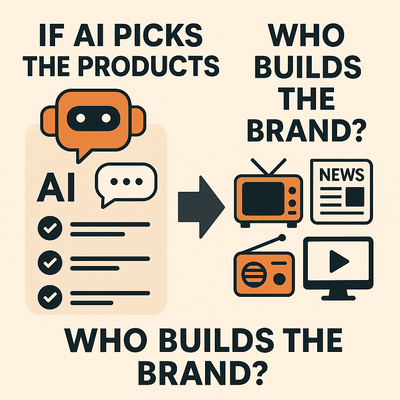
If AI Picks the Products, Who Builds the Brand? A Playbook for Local Media and Agencies
Agentic AI is turning chat-based assistants like ChatGPT into active shopping gateways that can recommend products, adjust prices, and even complete transactions—quietly reshaping how consumers discover retailers. To be visible in this new environment, retailers must own and optimize their product feeds into AI platforms, treating “agentic commerce” much like SEO or paid search. For local media reps and agencies, the opportunity is to position their outlets as the story layer above the algorithms—using radio, TV, print, and digital to build brand preference so AI recommendations land on familiar names. The winners will be those who help clients bridge clean AI integrations with emotionally compelling local campaigns, proving a distinctly human value in a machine-driven buying journey.

SEO isn’t dying — but this year it’s being rewritten from the ground up.
Generative Engine Optimization (GEO) is rapidly reshaping how consumers discover brands as personal AIs and chatbots increasingly replace traditional search. Instead of optimizing for keywords and rankings, marketers must now focus on what AI models “know” — ensuring their brands are cited within AI-generated answers. For local media reps and ad agencies, this shift opens opportunity: helping advertisers craft open, structured, and locally relevant content that AI systems can retrieve and recommend. In this new era, visibility isn’t just about showing up on page one — it’s about being the brand the AI chooses to mention first.

AI: A Research Channel Not A Conversion Channel — What Local Media Sellers and Ad Agency Professionals Must Know
BrightEdge’s 2025 industry report shows that AI-driven search is growing rapidly, but organic search remains the dominant driver of conversions and brand visibility. While AI referrals account for less than 1% of total traffic today, they are doubling month over month, signaling a major shift in how consumers discover products and services. For local media sales reps and ad agencies, this means combining traditional SEO with strategies that help clients appear in AI-generated results—through structured data, authoritative content, and local media mentions. The report emphasizes that local credibility and trusted content are becoming essential signals for AI models, giving local publishers and agencies a competitive edge. The key takeaway: success in 2025 requires selling not just impressions, but discoverability across both search and AI ecosystems.

How Local Media Sales Reps Can Use AI to Sell Smarter, Faster, and Better
Artificial Intelligence is transforming local media sales by enhancing—not replacing—the human touch, allowing reps to prospect smarter, understand clients more deeply, and optimize campaigns in real time. By integrating AI tools into their workflow, reps can automate routine tasks, personalize content, and build stronger relationships with clients. A step-by-step guide helps reps begin with one tool, experiment, and scale thoughtfully, while a curated resource section offers tools and platforms for learning and growth. Looking ahead, trends like voice AI, predictive seasonal modeling, and AI-generated commercials will reshape how local media connects with audiences. Ultimately, AI empowers reps to become strategic artisans—blending data and empathy to sell with integrity and impact.

Chatbots in Media Sales: The Promise, the Practice, and the Pitfalls
Chatbots are AI-powered tools that simulate human conversation and are and will be increasingly used in media sales to automate lead generation, campaign planning, and customer support. Companies like Sephora, H M, and regional newspapers have successfully deployed chatbots to improve engagement and streamline ad operations. The benefits include 24/7 availability, scalability, and data collection, but drawbacks such as poor user experience, limited understanding, and brand risk remain significant. Experts emphasize the importance of using chatbots strategically, with clear escalation paths and human oversight. Ultimately, chatbots are best used as productivity enhancers—not replacements for authentic, human-driven media relationships.

The Emails That Miss the Point: Why Human Communication Still Wins in the Age of AI
AI can write emails and summarize meetings, but it cannot detect emotional nuance, disengagement, or the subtle signals that require human leadership. Strong communication—not automation—is what drives productivity, trust, and team cohesion, especially in high-touch industries like media and advertising. For local media sales reps and ad agency professionals, relying too heavily on AI risks weakening client relationships and team dynamics that depend on empathy, accountability, and real conversation. Smart leaders use AI to support their work—but they lead through human connection, not machine-generated messages.