
If AI Picks the Products, Who Builds the Brand? A Playbook for Local Media and Agencies
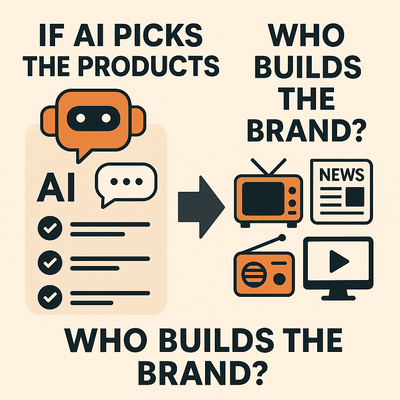
If you sell media for a living, you’ve spent the last decade watching Google and Amazon quietly siphon off product discovery. Now a new gatekeeper is forming in real time—inside chat windows.
Shoppers are no longer just searching for “best running shoes.” Increasingly, they’re asking an AI assistant what to buy and, in some cases, completing the transaction without ever touching a traditional website. OpenAI’s new Instant Checkout and its Agentic Commerce Protocol let people discover and buy products directly in ChatGPT, while Stripe, Etsy, Shopify, Walmart and PayPal rush to plug their catalogs into this new shopping lane. Reuters+3OpenAI+3Stripe+3
This is the world of agentic AI—and local media reps and agencies need to understand what it means for their retail accounts.
From “advice engine” to “action engine”
Traditional generative AI has been advisory: it suggests products, answers questions, drafts reviews. Agentic AI goes a step further. It analyzes data in near real time—inventory, pricing, customer history—and then takes action on the shopper’s behalf.
Think of an AI system that:
- Adjusts prices at a specific store based on local demand, inventory and competitor data
- Approves a refund instantly or flags a suspicious return as likely fraud
- Routes a customer to buy through ChatGPT instead of the brand’s own website
For local retailers, the in-store experience still matters. But the decision about where to go, what to buy and which brand to trust is increasingly being shaped upstream, in conversations with AI.
Why product feeds just became the new “prime shelf space”
To be chosen by an AI agent, a retailer has to exist in its universe. That’s where product feeds come in.
OpenAI’s Agentic Commerce Protocol is built around structured product data—live information about SKUs, prices, availability and media—that AI agents can read and act on. OpenAI+2DAC+2
Consultants now talk about “agentic commerce optimization” the way they once talked about SEO: whoever has the cleanest, most complete, most frequently updated feeds will surface more often when an AI assistant is deciding which retailer to recommend.
Early analyses show that traffic from generative AI to U.S. retail sites has exploded, with one report citing a 4,700% year-over-yearincrease—small in absolute terms today, but growing fast enough to make CMOs nervous about being invisible in these results. Financial Times
Simon’s blunt advice to retailers is simple: own your feeds. Build them internally, control the data quality and treat AI visibility the way you treat search and paid media performance.
For MarketingInsights.Info readers, that’s the pivot point. This isn’t just a technical problem; it’s a media and storytelling problem.
What this means for local media reps and agencies
Most local retailers are not ready for agentic commerce. They’re still arguing about whether to fix their website, much less expose a real-time catalog to AI agents.
That’s an opening for you.
1. Add “AI shelf space” to your needs analysis
The next time you sit with a regional furniture chain, home-improvement retailer or specialty shop, don’t just ask about Google, Meta and co-op dollars. Ask:
- “Are your products currently visible in AI assistants like ChatGPT or Copilot?”
- “Do you have a structured product feed today—and who controls it?”
- “If an AI assistant recommended three options in your category, what’s your plan to be one of them?”
2. Position your media as the story layer above the agents
Agentic AI is very good at logistics: inventory, price comparisons, delivery windows. It is not emotionally compelling. It doesn’t tell the origin story of a local brand or capture the feel of walking into a neighborhood store.
That’s where local media still wins:
- Audio and video spots that give a retailer a voice and a personality
- News and feature sponsorships that connect them to community issues
- Branded content explaining why buying local matters, not just where to click
3. Build packages that bridge broadcast, digital and AI discovery
The retailers who become “winners” in agentic AI will do three things well:
- Maintain clean, accurate product feeds into AI platforms DAC+1
- Run smart, accountable media campaigns that build demand for their brand
- Capture first-party data so they’re not entirely dependent on external algorithms
- On-air storytelling and promotions to drive mental availability
- High-impact digital—video, audio streaming, newsletters, branded content—tied to specific categories (“back-to-school tech,” “holiday entertaining,” “home refresh”)
- Lead-gen components on your sites and apps that collect email and permissions, giving retailers an owned channel beyond the AI platforms
A moving target through 2026
The 2025 holiday season is likely to be messy: some big brands live inside chat-based shopping, others absent; consumers experimenting with asking AI for “gift ideas under $50” and sometimes buying straight from the thread. Analysts expect 2026 to look very different again as more merchants plug into protocols like ACP and as partnerships—like recent deals between ChatGPT and payments giants—spread through the ecosystem. PMG - Digital Company+2Reuters+2
For local media, that means two parallel responsibilities:
- Help your clients avoid being invisible in AI-assisted shopping.
- Protect your own role as the channel that shapes desire, not just captures leftover demand.
If your sellers and strategists can speak fluently about that shift, you become more than “traditional media.” You become the guide that helps retailers navigate a world where algorithms don’t just rank results—they make the first move in the sale.
In that sense, agentic AI is less a threat than a mirror. It forces everyone in the local media ecosystem to answer a simple question: when the machines start doing some of the selling, what distinctly human value are you bringing to the table?
The outlets that can answer that clearly—and prove it with campaigns that move both people and product—are the ones that will still matter when the next wave of commerce arrives.