
The Thanksgiving Weekend Paradox: Why It Still Matters—and How Local Media Can Win
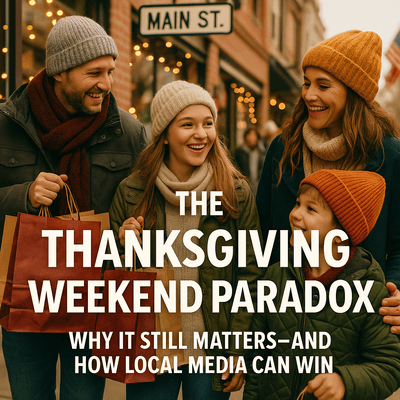
Every November, the same question surfaces in boardrooms and marketing meetings: Does Thanksgiving weekend still matter? After all, the holiday shopping season now stretches from early October to late December. Deals start before Halloween. Cyber Monday feels like Cyber Month. Surely, the old five-day ritual is losing relevance.
And yet, consumers answer the question every year with remarkable consistency: Yes, it matters. This year, despite economic uncertainty, inflation anxiety, and a cultural shift toward “buy less, buy better,” 88% of U.S. adults—roughly 235 million people—plan to spend $127 billion between Thanksgiving Day and Cyber Monday, according to the International Council of Shopping Centers (ICSC). That’s not just commerce; it’s a cultural reaffirmation.
Why This Moment Persists
To understand why Thanksgiving weekend remains a retail juggernaut, you have to look beyond economics and into psychology. These five days are not merely about transactions; they’re about rituals. Americans gather around tables, watch football, and then—almost instinctively—shop. It’s a shared rhythm, a collective pause before the December sprint.
Tom McGee, ICSC’s president and CEO, puts it plainly:
“Every year, there’s a question about whether the long holiday weekend still matters. And every year, the answer from consumers is the same: it does.”
Why? Because shopping during Thanksgiving weekend is not just about acquiring goods; it’s about signaling abundance, generosity, and optimism—even in lean times. It’s a cultural script that says: We’re okay. We can celebrate.
The Numbers Behind the Mood
Consumers expect to spend $542 on average, up slightly from last year’s $529. Millennials lead the charge at $764 per person, while Gen Z shows the strongest momentum—nearly six in ten plan to spend more than in 2024. These aren’t just demographics; they’re mindsets.
- Millennials: In their prime earning years, balancing family obligations with aspirational lifestyles. They want experiences and convenience.
- Gen Z: Digital natives who see shopping as entertainment. For them, a retail center is not just a store—it’s a stage for social life.
Here’s the twist: Thanksgiving weekend isn’t about choosing between online and in-store. It’s about doing both. 83% will shop in physical stores, led by Gen Z, and 83% will shop online for delivery. More than half will order online and pick up in-store. This is the omnichannel reality—fluid, impatient, and expecting seamlessness.
For local media sellers, this means advertisers need campaigns that speak to both worlds. Radio spots that drive urgency. Digital ads that reinforce convenience. Messaging that says: We’re everywhere you are.
The Experience Economy
Eighty percent of shoppers plan to visit a retail center, not just to buy but to dine, to be entertained, to feel festive. Fifty-nine percent will shop, 48% will eat out, and 28% will attend holiday events. This is where local media shines. You’re not just selling ad space; you’re selling a connection to community rituals.
When a retailer sponsors a holiday concert or a local radio station broadcasts live from a shopping center, that’s not advertising—it’s cultural participation. It’s embedding a brand in the soundtrack of the season.
The Psychology of Deals
Consumers remain deal-driven. 59% cite discounts as their primary reason for shopping, and nearly three-quarters plan to use sales to stock up on everyday items. Promotions aren’t just incentives; they’re coping mechanisms. In a world of rising prices, a good deal feels like a small victory.
For ad agencies, this means creative that doesn’t just announce a discount but frames it as a moment of empowerment: You’re smart. You’re winning. That’s the emotional hook.
The AI Factor
Here’s the curveball: 63% of shoppers plan to use AI tools—ChatGPT, Gemini, retail chatbots—to find deals, compare prices, and organize shopping lists. Gen Z leads at 80%, millennials at 72%. This isn’t science fiction; it’s the new shopping assistant.
For local media, this means advertisers need messaging that’s AI-friendly—structured data, clear offers, and language that algorithms can parse. The future of advertising isn’t just human persuasion; it’s machine readability.
Historical Context: Why Rituals Outlast Trends
Think back to the early 2000s, when e-commerce was supposed to kill Black Friday. Or 2020, when the pandemic shuttered malls and accelerated digital adoption. Each time, the obituary was premature. Why? Because rituals adapt. They absorb technology without losing their essence.
Thanksgiving weekend has evolved from doorbusters to digital codes, from midnight lines to mobile alerts. But the underlying impulse—the desire to mark a moment with shared consumption—remains intact. That’s why this weekend still matters.
Actionable Strategies for Local Media Sellers
So, what do you do with this insight? Here are five strategies:
- Sell Radio as the Holiday Companion
Radio reaches consumers in their cars as they head to stores, in their kitchens as they plan meals, and on smart speakers as they browse online. Position radio as the medium that moves with the consumer. - Bundle Broadcast with Digital Extensions
Offer streaming audio, podcast sponsorships, and social integrations. Create omnichannel packages that mirror consumer behavior. - Pitch Community Integration
Encourage advertisers to sponsor local events, holiday concerts, and charity drives. Use radio to amplify these efforts and position brands as community builders. - Leverage AI in Campaign Planning
Help clients structure offers and messaging so they’re easily discoverable by AI shopping assistants. This is a new frontier—be the guide. - Frame Deals as Emotional Wins
Consumers aren’t just looking for discounts; they’re looking for reassurance. Craft copy that celebrates smart choices and festive abundance.
Thanksgiving weekend isn’t just a retail event; it’s a cultural ritual that persists through recessions, pandemics, and technological revolutions. Consumers aren’t just spending money; they’re buying reassurance, belonging, and joy. For local media and agencies, the opportunity isn’t to chase clicks—it’s to shape meaning. And in a fragmented world, that’s the most valuable currency of all.
Source: https://chainstoreage.com
.png)
.png)
.png)