

Failed Sales Strategies: Why They Happen
Frustrated with failed sales strategies? You put together a robust sales strategy—a strategy that you worked extremely hard on and believed to be near flawless—only to see it fail in the long run. Frustrating, right? In my years of consulting, I have rarely (and I mean rarely!) come across a seriously flawed sales strategy. However, I have come across many (and I mean many!) sales strategies which ultimately fail.
.png)
What the FTC’s Pricing Crackdown Means for Radio, TV, Print, Digital and Outdoor
The FTC’s March 13 warning letters to 97 dealership groups signal that auto advertising is entering a period of sharper scrutiny, especially around price transparency, mandatory fees, financing conditions and vehicle availability. For local media sellers and ad agencies, this is not just a compliance issue but a business issue, because misleading offers can undermine campaign performance across radio, TV, print, digital and outdoor by eroding consumer trust. The opportunity for media professionals is to help dealers create cleaner, more consistent and more credible messaging that improves both legal defensibility and sales effectiveness.
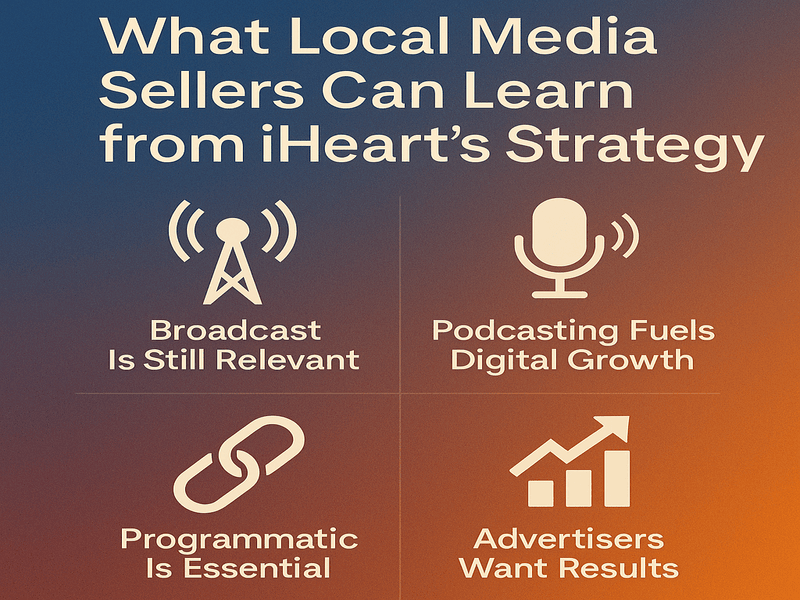
How iHeart’s Growth Strategy Signals Key Trends for All Local Media Sellers
iHeartMedia rsquo;s latest earnings report offers an encouraging look at how legacy media companies can successfully adapt to the evolving advertising landscape. While digital remains the fastest-growing division mdash;led by podcasting mdash;there are signs of stabilization and renewed momentum in broadcast radio, particularly in national network sales. The company rsquo;s focus on ad tech, programmatic inventory, AI-driven efficiencies, and integrated media sales serves as a useful playbook for local sellers across all media. For newspapers, magazines, TV, digital platforms, and billboards, the big takeaway is clear: advertisers want multiplatform solutions, measurable performance, and efficient reach mdash;and media companies who deliver those will win.

Convenience Stores 2022: A Smoother Road Ahead
Convenience stores did their best to remain convenient to customers during the pandemic; however, the abrupt change to many people’s work schedules and their reluctance to shop inside stores disrupted the entire convenience store model. With fewer people working and remaining at home, the demand for motor fuel declined significantly. Similar to many other local businesses, convenience stores have continued to face labor challenges and supply-chain issues.
Restaurants: Ready to Rebuild from Ruin
Few retail sectors have suffered as much from the pandemic as restaurants. It doesn’t just affect the cash register till, but also employment (often teens and younger adults), payroll and sales taxes and tourism. Although some major chains may experience significant revenues losses, and even bankruptcy, it’s the independents and mom-and-pop establishments which are experiencing the brunt of state-mandated closures.

Tips for Practicing One-On-One Listening to Improve Internal Comms
Companies are recognizing listening’s impact on retention, productivity, and culture by installing macro-organizational listening strategies. Strategies include designating a chief listening officer, hiring listening consulting firms and employing organization-wide listening mechanisms like engagement surveys; pulse-taking during exit, onboarding, and post-merger interviews; crowdsourcing methods like suggestion boxes or polling on specific topics.

Management Insights: The Art of Leading a Winning Sales Team
In the bustling world of media ad sales, a veteran General Sales Manager (GSM) is akin to a seasoned captain steering a ship through ever-changing waters. As digital waves crash and consumer winds shift, how can you, the experienced captain, lead your crew to success? Let’s dive into a story that illustrates the journey and uncover strategies to enhance your team’s performance and boost sales.

Comprehensive Hiring Checklist: Next-Gen Local Media Sellers
Hiring the next generation of local media sellers requires a shift from legacy experience to candidates who are digitally curious, data-literate, and self-motivated to win. Top performers are organized, goal-driven, and possess a natural competitive spirit that fuels consistent follow-through and client success. Strong hires also demonstrate consultative selling skills, storytelling ability, and a passion for helping local businesses thrive. Managers should watch for red flags like tech aversion, disorganization, and a transactional mindset, which often signal underperformance. By focusing on mindset, adaptability, and strategic thinking, local media companies can build sales teams equipped to lead in a hybrid, AI-enhanced marketplace.
.png)
The Super Bowl’s Real Lesson for Local Marketers: Creativity Isn’t a Cost—It’s a Multiplier
Most advertising gets skipped or avoided, but the Super Bowl flips the dynamic by making ads genuinely entertaining—and that reveals an economic truth: creativity multiplies the return on media spend. Research from groups like System1/Effie and Nielsen suggests creative quality is a major driver of profit and sales lift, not a “nice-to-have.” Beyond paid reach, culturally resonant creative generates earned attention—conversation, sharing, and search behavior—that extends impact well past the media buy. For local media sellers and agencies, the practical move is to sell “creative + distribution + simple proof,” building campaigns designed to be remembered and talked about, not merely delivered.

From Fringe to Frontline: Podcasting’s Rise to New Revenue Path for Local Media and Agencies
Podcast advertising continues to outperform expectations, with Nielsen data showing strong lifts in brand awareness, purchase intent, and consumer engagement across nearly 2,000 case studies. Host-read ads are especially effective, with listeners rating podcast hosts as likeable, credible, and relatable—making brand endorsements feel authentic and trustworthy. The medium commands 19% of daily ad-supported audio time among U.S. adults, with even higher engagement among younger and Hispanic audiences. Local media companies, sales reps, and ad agencies can capitalize on this trend by launching community-focused podcasts and offering host-read ad packages to regional advertisers. As podcasting grows, it offers local professionals a powerful new channel for storytelling, brand building, and audience connection.

The Steadily Rising Power of U.S. Latinos: What Local Media and Ad Agencies Need to Know
The U.S. Latino economy now produces roughly $3.6 trillion in annual GDP, making it one of the world’s largest and fastest-growing markets. Within that growth, Latinas (Hispanic women) contribute about $1.3 trillion in economic output and drive most household purchasing decisions. Younger cohorts— Gen Z and Gen Alpha—are highly bilingual, racially mixed, and expect brands to demonstrate authenticity and cultural relevance. Hispanic households show wide diversity in country of origin, language use, and multigenerational structure, demanding more nuanced marketing than one-size-fits-all campaigns. For local media sales teams and ad agencies, tailoring content and ad packages to these demographic, cultural, and technological shifts is critical to capturing a rapidly expanding share of consumer spending.

Boosting Morale and Retention: The Essential Role of Sales Training in Modern Business
Sales teams are vital to business growth, yet they often face high turnover and low morale. Effective sales training programs not only enhance performance but also play a crucial role in boosting employee morale and retention. Investing in sales training provides salespeople with the skills and confidence they need, reducing stress and increasing job satisfaction. Research indicates that companies with robust sales training programs experience significantly lower turnover rates, with improved employee income and retention.

12 Sales Games to Level Up Your Team and Close More Deals
In the dynamic world of sales, regular training is essential. Whether you’re adapting to emerging trends, changing circumstances or new technology, continuous learning is an important part of staying ahead of the curve and optimizing sales performance. Sales games make training fun and interactive. They’re an effective way to help your sales teams develop and retain new skills.

Mastery and Self-Made Brian Tracy: The Complete Blueprint for Sales Success
From Charity Clothes to Global Influence: The Foundation Years
Brian Tracy transformed himself from a poverty-stricken high school dropout in Prince Edward Island into one of the world's leading success and sales authorities through systematic self-education and disciplined study of masters like Napoleon Hill and Dale Carnegie. He developed practical systems like the ABCDE priority method, the 10-goal system, and consultative selling techniques by treating real-world sales interactions as scientific experiments to refine his approach. His influence has reached millions across 58 countries through books, seminars, and audio programs that prove success comes from systematic daily habits and continuous learning rather than natural talent. Tracy's enduring legacy demonstrates that ordinary people can achieve extraordinary results by consistently applying his learnable systems for time management, goal-setting, and sales psychology.

Phil Knight’s Quiet Ferocity: What Nike’s Founder Can Teach Media Sellers And Ad Agency Professionals About Building a Market, a Brand—and a Life
Phil Knight built Nike by fusing product truth with narrative power—an introverted runner who learned from coach Bill Bowerman to obsess over small improvements, then turned them into big markets. Starting as a cash-starved distributor, he sold urgently under constraint, listened closely to athletes, and transformed customers into evangelists, culminating in athlete-driven storytelling and “Just Do It.” His strengths—resilience, talent-spotting, and disciplined risk—were shadowed by blind spots (conflict avoidance and early missteps on overseas labor), which he addressed by upgrading systems and standards. For media sellers and agencies, the playbook is clear: start where results are provable, make the calendar your co-seller, keep one simple message, and design measurement that proves lift. The deeper lesson is cultural—treat constraints as creative fuel and build a brand worthy of belief, one disciplined iteration at a time.