

Political Ad Spending Poised to Shatter Midterm Records in 2026 — What It Means for Local Media and Agencies
Political ad spending is projected to reach $10.8 billion in 2026, making it the most expensive midterm cycle in U.S. history. Broadcast TV will still capture nearly half of this spending, but Connected TV (CTV) will surge to $2.5 billion, reshaping campaign strategies and demanding integrated media solutions. Swing states like California, Michigan, Texas, Georgia, and North Carolina will see the heaviest demand, with inventory scarcity and premium pricing affecting both political and non-political advertisers. Early buying is already breaking records, meaning agencies and local reps must help clients secure placements well in advance. For local media and agencies, the opportunity lies in balancing short-term political windfalls with long-term client relationships through cross-platform strategies and consultative selling.

How to Unmask Objections to Close the Deal
These are examples of objections we often hear in the middle to the end of the sales cycle. One thing that hasn’t changed in the wake of COVID-19 is the necessity of sales professionals to respond effectively to buyer objections. Objections are explicit communications from a prospect that they are resisting or not planning to move forward with a purchase, which become a barrier to advancing and closing the sale.

Sara Blakely: The Art of the Unseen Revolution
Sara Blakely, founder of Spanx, transformed a personal frustration with pantyhose into a billion-dollar brand by blending grit, humor, and outsider thinking. With no background in fashion or business, she taught herself patent law, pitched her product door-to-door, and earned Oprah’s endorsement, launching Spanx into national fame. Her success is rooted in empathy, authenticity, and a growth mindset that embraces failure as fuel. Blakely’s marketing strategy relied on storytelling over ad spend, and her leadership style fosters vulnerability, purpose, and resilience. Beyond business, she’s a philanthropist, adventurer, and prank-loving mom who believes joy and discomfort are both essential to growth.

CONSUMERS 2018, PART 1
People and, therefore, consumers are complex creatures. It’s even more the case today, as the world, in general, and the lives we live, specifically, bear little or no resemblance to the world and the lives of our childhood, whether we are Baby Boomers or Millennials. The rapid technological transformations we are experiencing today and those that will overwhelm and amaze us during the remainder

Chatbots in Media Sales: The Promise, the Practice, and the Pitfalls
Chatbots are AI-powered tools that simulate human conversation and are and will be increasingly used in media sales to automate lead generation, campaign planning, and customer support. Companies like Sephora, H M, and regional newspapers have successfully deployed chatbots to improve engagement and streamline ad operations. The benefits include 24/7 availability, scalability, and data collection, but drawbacks such as poor user experience, limited understanding, and brand risk remain significant. Experts emphasize the importance of using chatbots strategically, with clear escalation paths and human oversight. Ultimately, chatbots are best used as productivity enhancers—not replacements for authentic, human-driven media relationships.

Strengthen Your Leadership with the Science of Awe
This Nano Tool for Leaders from Wharton Executive Education offers techniques for developing an “awe mindset” for greater creativity, improved collaboration, and better decision-making. Nano Tools for Leaders® — a collaboration between Wharton Executive Education and Wharton’s Center for Leadership and Change Management — are fast, effective tools that you can learn and start using in less than 15 minutes, with the potential to significantly impact your success.

Holiday Chaos, Local Opportunity: How Media Sellers Can Help Shoppers Find Their Way
Consumers plan to spend the same or more this holiday season despite financial pressures, but many feel overwhelmed by promotional noise and are abandoning purchases out of frustration. Generative AI is emerging as a “holiday helper,” giving shoppers curated recommendations and clearer choices—if retailers feed it structured, consistent content. At the same time, physical stores are reclaiming center stage as experiential hubs and omnichannel switchboards, from community-driven formats to BOPIS, returns and in-store events that build confidence and connection. For local media sellers and agencies, the opportunity is to help retailers simplify decisions, turn stores into local events, align AI and in-store promises, and ultimately sell confidence rather than just more clutter.
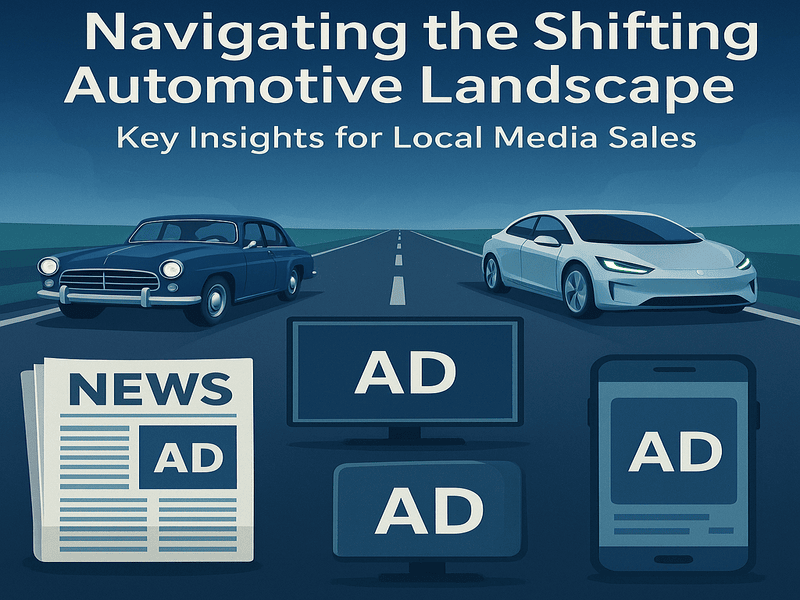
Navigating the Shifting Automotive Landscape: Key Insights for Local Media Sales
This article provides valuable insights for local media salespeople in newspapers, magazines, billboards, TV, and digital platforms. It covers recent developments in the automotive industry, including tariff adjustments, technological advancements, and production shifts. Understanding these changes can help media sales professionals tailor their strategies to better serve automotive clients and capitalize on new advertising opportunities.

The Gift: Turning Holiday Shopper Stress Into Local Media Sales Opportunity
Holiday shopping stress is surging, with 84% of consumers abandoning carts due to feeling overwhelmed, according to Accenture’s 2025 Holiday Shopping Survey. Younger shoppers are especially prone, with 89% of Gen Z and 91% of millennials reporting they walk away from purchases. The survey also found 82% of consumers feel overwhelmed by advertising and 77% cite too many options, up sharply from prior years. While this poses a risk to retailers, it also presents an opportunity for local merchants to stand out by simplifying choices, highlighting human expertise, and creating stress-free shopping experiences. For local media sales reps and agencies, the key is positioning clients as solution providers, using advertising that cuts through the noise with clarity, trust, and confidence.
.png)
The $750 Billion Paradox: AI’s High-Converting Future Is Shackled by Search Engine Economics
The shift to AI-driven search is inevitable and shows rapid consumer adoption, but its immediate dominance is hindered by severe economic and infrastructural constraints, meaning the revolution will likely manifest closer to 2028-2030, not the projected 2026. The core friction is the astronomical operational cost, as a single AI query consumes ten times the electricity of a traditional search, preventing mass rollout and necessitating selective feature integration by major platforms. Although AI-driven referrals currently account for less than 1% of total web traffic, these users convert 23 times higher than traditional organic search traffic, signaling a profound shift in consumer intent that is projected to drive $750 billion in spending by 2028. For advertisers, the immediate strategic imperative is adapting to the "zero-click" economy by prioritizing authoritative content for AI citation and dedicating greater resources to paid search, as its premium placement above AI Overviews has become critically important for visibility.
.png)
What the FTC’s Pricing Crackdown Means for Radio, TV, Print, Digital and Outdoor
The FTC’s March 13 warning letters to 97 dealership groups signal that auto advertising is entering a period of sharper scrutiny, especially around price transparency, mandatory fees, financing conditions and vehicle availability. For local media sellers and ad agencies, this is not just a compliance issue but a business issue, because misleading offers can undermine campaign performance across radio, TV, print, digital and outdoor by eroding consumer trust. The opportunity for media professionals is to help dealers create cleaner, more consistent and more credible messaging that improves both legal defensibility and sales effectiveness.

A Sales Manager Tells You How to Succeed When Selling with Your Boss
“I like to point out strengths that my coworker brings to the table as part of the introduction to build confidence and credibility right away.” Have you taken your boss on a sales call recently? You could build two relationships simultaneously—one with your manager and a better one with the client. The more trust between you and the manager, the more opportunities may come your way. And your client may be impressed with the expert “team” you put in front of them to solve their problems.

Top 10 Sales Manager Mistakes and How to Avoid Them
As a sales manager, it’s crucial to avoid common pitfalls that can negatively impact team performance. Here’s how to navigate ten key mistakes: Assuming Everyone Works Like You: Establish clear KPIs to guide different working styles. Hiring Based Solely on Experience: Prioritize performance over experience. Delaying Firings: Act quickly when someone isn’t performing. Failing to Identify Bad Reps: Remove toxic or unproductive reps promptly. Relying on Activity over Results: Focus on outcomes, not just activity. Allowing Low Win Rates: Coach reps, but don’t tolerate chronic underperformance.

How Lack of Research and Confidence Undermine Your Cold Calling Success
Are your cold calls falling flat because you’re making simple mistakes? The salesperson called me, but I couldn’t talk at that moment. I was busy focused on something and was unwilling to stop, although I usually take cold calls. If you make cold calls, you should take them because you may learn from different approaches.
Media Usage Expected to Dip in 2025 - Why It’s a Wake-Up Call for U.S. and Canadian Media Sellers
For the first time since 2009, total media usage across the U.S. and Canada is expected to decline, with a projected 0.3% dip in 2025 according to PQ Media. The slowdown highlights how digital media growth can no longer offset traditional media declines — but it also reinforces that traditional media still commands strong, high-quality audiences. For local media sellers, it’s a prime opportunity to position broadcast, print, and trusted digital outlets as powerful, stable options for advertisers aiming to maximize reach in a fragmented landscape.