
.png)
Strategic Reversion to Owned Channels: Marketers Reinvest in Email as AI Becomes Essential Infrastructure
After years of chasing rented reach on big platforms, marketers are swinging back toward owned channels, (email lists, newsletters, website, blogs, traditional medium, podcasts, loyalty programs, social pages) with 65% planning to reinvest in email while using AI as core infrastructure to drive personalization, speed, and efficiency. It shows that no single owned channel dominates—email, SMS, loyalty programs, apps, and physical locations all contribute—while paid channels like search, retail media, CTV, and social continue to grow as feeders into those owned relationships rather than replacements. The story highlights a major gap in podcast adoption versus perceived opportunity, rising investment in account-based marketing, and a broader shift from demographic targeting to community- and values-based brand building, with data privacy and trust as central themes. For local market media reps and agencies, there’s a playbook to sell “total local ecosystems” (email + CTV + audio + community), to make AI’s benefits concrete in local campaigns, and to position themselves as the strategists who help brands build durable, owned relationships—not just buy impressions.
.png)
Connected TV Is Grabbing the Political War Chest. Where Does That Leave Local Media?
An expected $10 billion in 2026 political ad spending is rapidly shifting toward connected TV, forcing local media and agencies to repackage their traditional strengths—reach, trust, and local context—into more data-rich, addressable offerings. How are firms like Fyllo, forged in highly regulated categories like cannabis and financial services, using contextual and CTV tools to give campaigns precise, privacy-safe targeting in swing districts. The story explores the growing importance of sports as “safe reach” inventory, the rise of contextual platforms such as Proteus, and the ongoing challenges of fragmented CTV measurement. It includes a practical playbook for local sellers and agencies to own their CTV story, leverage sports and local news as high-value targeting environments, and turn regulatory and privacy complexity into a competitive advantage.
.png)
Political Advertising's New Playbook: What Local Media and Ad Pros Need to Know for 2026
The political advertising landscape for the 2026 cycle is being redefined by four key trends critical for local media and ad agencies. First, campaigns are shifting spending toward localized content creators and micro-influencers to achieve targeted reach, demanding that media outlets partner, not just compete, with these organic strategies. Second, Artificial Intelligence is moving into the creative front-end of advertising, pressuring agencies to adopt AI tools for creative optimization and requiring media sellers to articulate the unique, human value of their inventory. Third, the scrutiny on high-pressure digital fundraising tactics creates an opportunity for trusted local media channels to host high-credibility, nuanced campaign narratives. Finally, new, affordable AI-powered systems are enabling the professionalization of down-ballot races, dramatically expanding the pool of sophisticated local ad buyers.
.png)
Total TV, Local Dollars: How Ad Tech Is Rewriting the Rules for Local Media Sales
Ad tech is transforming TV from a simple spot-and-break business into a unified “Total TV” ecosystem where linear, streaming and CTV inventory are sold, targeted and measured together. For local media sellers and agencies, that means shifting from selling GRPs and dayparts to selling audiences and impressions across platforms, using tools like dynamic ad insertion, new streaming ad formats and unified campaign automation. CTV and OTT now deliver real-time, digital-style metrics—reach, frequency, completion rates and attribution—that let local outlets compete more directly with search and social for performance-driven budgets. AI is beginning to power optimization, data onboarding and contextual targeting, creating efficiency and better campaign results, and giving local media a more sophisticated, data-backed story to take into every client meeting.
.png)
.png)
.png)
In-Store Shopping: Critical Channel for Holiday Sales Season
Physical retail maintains strong pull despite e-commerce growth, offering local media and agencies key targeting opportunities. Despite e-commerce growth, 76% of consumers consider in-store shopping a holiday ritual, with three-quarters saying it's essential to feeling festive and connected. Physical stores drive higher-value purchases, as 70% of shoppers feel more comfortable buying premium items in-store versus 30% online, while 72% trust in-store quality more than online options. The research challenges Black Friday's effectiveness, with 84% of consumers preferring deals spread throughout November and December rather than concentrated one-day events. For local media sales reps and agencies, the data suggests opportunities in sustained promotional campaigns, experiential retail messaging, and targeting Gen Z shoppers who show the strongest affinity for in-store discovery.
.png)
Target vs Walmart: The Power of Simple Value Over Purpose-driven Marketing
This year's Black Friday performance highlighted a critical lesson for local media advertisers: simple, benefit-driven value messaging is far more effective at driving traffic and sales than purpose-driven brand positioning. While Walmart achieved record sales by focusing maniacally on its "Save Money. Live Better" promise, Target struggled, suggesting its focus on socio-cultural initiatives came at the expense of core retail value. For local retailers, the takeaway is clear: marketing budgets should prioritize consistent, clear communication of price, product, service, and availability to motivate the middle-class consumer. Media sales professionals should advise clients to shift the conversation from corporate virtue to tangible customer benefits to maximize transactional performance.
.png)
The $750 Billion Paradox: AI’s High-Converting Future Is Shackled by Search Engine Economics
The shift to AI-driven search is inevitable and shows rapid consumer adoption, but its immediate dominance is hindered by severe economic and infrastructural constraints, meaning the revolution will likely manifest closer to 2028-2030, not the projected 2026. The core friction is the astronomical operational cost, as a single AI query consumes ten times the electricity of a traditional search, preventing mass rollout and necessitating selective feature integration by major platforms. Although AI-driven referrals currently account for less than 1% of total web traffic, these users convert 23 times higher than traditional organic search traffic, signaling a profound shift in consumer intent that is projected to drive $750 billion in spending by 2028. For advertisers, the immediate strategic imperative is adapting to the "zero-click" economy by prioritizing authoritative content for AI citation and dedicating greater resources to paid search, as its premium placement above AI Overviews has become critically important for visibility.
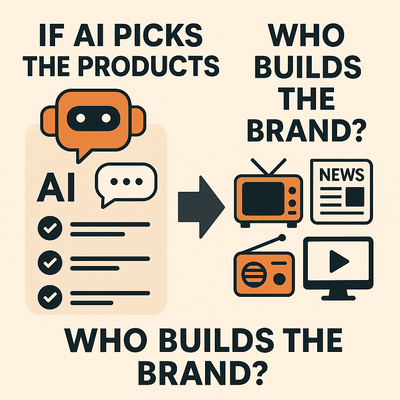
If AI Picks the Products, Who Builds the Brand? A Playbook for Local Media and Agencies
Agentic AI is turning chat-based assistants like ChatGPT into active shopping gateways that can recommend products, adjust prices, and even complete transactions—quietly reshaping how consumers discover retailers. To be visible in this new environment, retailers must own and optimize their product feeds into AI platforms, treating “agentic commerce” much like SEO or paid search. For local media reps and agencies, the opportunity is to position their outlets as the story layer above the algorithms—using radio, TV, print, and digital to build brand preference so AI recommendations land on familiar names. The winners will be those who help clients bridge clean AI integrations with emotionally compelling local campaigns, proving a distinctly human value in a machine-driven buying journey.

Holiday Chaos, Local Opportunity: How Media Sellers Can Help Shoppers Find Their Way
Consumers plan to spend the same or more this holiday season despite financial pressures, but many feel overwhelmed by promotional noise and are abandoning purchases out of frustration. Generative AI is emerging as a “holiday helper,” giving shoppers curated recommendations and clearer choices—if retailers feed it structured, consistent content. At the same time, physical stores are reclaiming center stage as experiential hubs and omnichannel switchboards, from community-driven formats to BOPIS, returns and in-store events that build confidence and connection. For local media sellers and agencies, the opportunity is to help retailers simplify decisions, turn stores into local events, align AI and in-store promises, and ultimately sell confidence rather than just more clutter.

Holiday Shopping Surge Signals Banner Season for Local Advertisers
A record 186.9 million Americans plan to shop from Thanksgiving through Cyber Monday, creating unprecedented opportunities for local media sales and advertising agencies as retailers compete during the industry's most critical period. While Black Friday remains dominant with 130.4 million expected shoppers, Saturday's local business focus and 59% of shoppers using digital wallets demand multi-platform strategies spanning the entire weekend. With 58% of consumers already shopping by early November and total spending forecast to exceed $1 trillion, advertisers must launch campaigns earlier with value-driven messaging across search, mobile, and geo-targeted channels.
Reaching Generation Z: How Local Media Can Ride the Tik Tok Wave
Gen Z is reshaping how news is consumed, with 40% getting most of their information from TikTok or X. Influencers like Kelsey Russell, known as The Print Princess, are turning print stories into personality-driven videos that resonate with younger audiences. This trend reflects a deeper need for cohesive narratives in a fragmented media landscape and offers local media sales teams a unique opportunity: integrate TikTok strategies to connect advertisers with Gen Z. Practical steps include turning newsroom talent into creators, partnering with influencers for behind-the-scenes content, and bundling TikTok with traditional media to deliver authenticity and measurable ROI. The Media Audit provides the data to target fast-growing categories and position radio as a relevant solution in this evolving market.

The New American ATM: Inside the HELOC Surge—and How Local Media Can Cash In
Home equity lines of credit (HELOCs) are surging again in 2025–2026 as homeowners sitting on record equity and ultra-low first-mortgage rates look for smarter ways to fund renovations and consolidate high-interest debt. HELOCs growth is a great opportunity for local media. Unlike the pre-2008 era, today’s growth is driven by more disciplined, prime borrowers and stricter underwriting, making HELOCs a strategic tool rather than a reckless ATM. Banks, credit unions, and fintechs are all racing to capture this demand, but local media are uniquely positioned to help them win by combining trusted storytelling with data-driven targeting of equity-rich homeowners. For local media sellers and agencies, this creates a timely opportunity to build HELOC campaigns around real-life use cases—“don’t move, improve,” credit-card cleanup, and life events—while pairing brand messaging with performance channels. Ultimately, the HELOC revival reveals a middle class trying to regain control in an anxious economy, using their homes not to splurge, but to stabilize their financial lives.
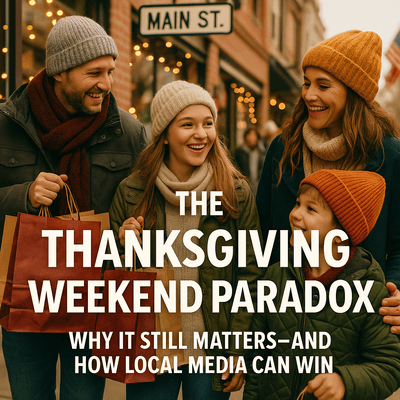
The Thanksgiving Weekend Paradox: Why It Still Matters—and How Local Media Can Win
Thanksgiving weekend remains a cultural and commercial powerhouse, with 88% of U.S. adults planning to spend $127 billion despite economic uncertainty. Millennials and Gen Z lead the charge, driving omnichannel shopping behaviors that blend online convenience with in-store experiences. Consumers are highly motivated by deals, with nearly three-quarters using the weekend to stock up on essentials and 63% leveraging AI tools to find the best offers. For local media sellers and ad agencies, this is a prime opportunity to position radio as the holiday companion—trusted, local, and omnipresent—while bundling it with digital extensions for maximum reach. The big takeaway: Thanksgiving weekend isn’t just about transactions; it’s about rituals, meaning, and community—making local media the perfect bridge between brands and consumers.