
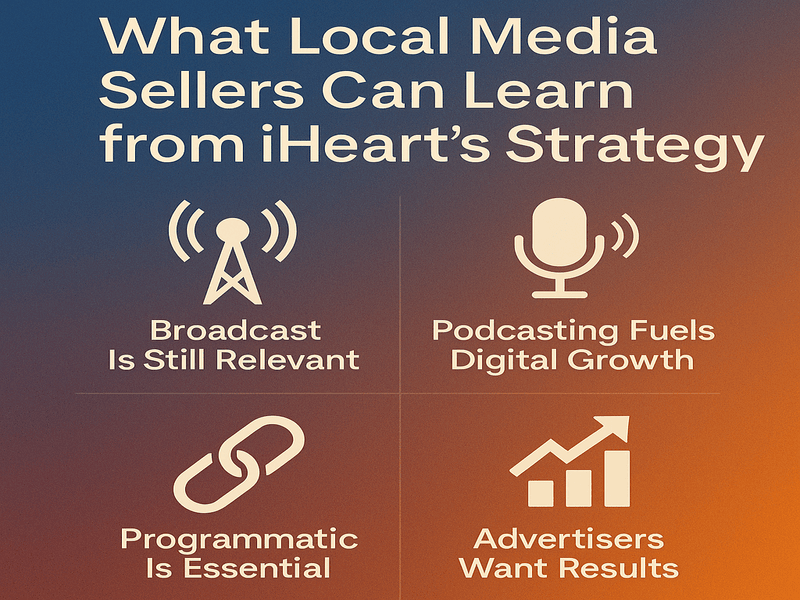
How iHeart’s Growth Strategy Signals Key Trends for All Local Media Sellers
iHeartMedia rsquo;s latest earnings report offers an encouraging look at how legacy media companies can successfully adapt to the evolving advertising landscape. While digital remains the fastest-growing division mdash;led by podcasting mdash;there are signs of stabilization and renewed momentum in broadcast radio, particularly in national network sales. The company rsquo;s focus on ad tech, programmatic inventory, AI-driven efficiencies, and integrated media sales serves as a useful playbook for local sellers across all media. For newspapers, magazines, TV, digital platforms, and billboards, the big takeaway is clear: advertisers want multiplatform solutions, measurable performance, and efficient reach mdash;and media companies who deliver those will win.

Pediatricians Presentation
Market Size: The US pediatric healthcare market is estimated at $15.32 billion in 2024, projected to reach $18.64 billion by 2029, growing at a CAGR of 4% (Mordor Intelligence). Total child population in the US: Approximately 74 million, with larger distribution in Urban areas with higher population density (Source: US Census Bureau). Insurance coverage: Approximately 90% of children are insured (Source: Kaiser Family Foundation)

CO-OP ADVERTISING: MAKING THE MOST OF CO-OP DOLLARS
US manufacturers allocate approximately $36 billion to $70 billion, annually, as co-op funds for which many (if not most) local SMBs, dealers, retailers and advertisers qualify to add to their advertising budgets. Some brains are obviously not so clear about the value and availability of co-op dollars, and how to use them, because approximately $14 billion to $35 billion are never used.

Convenience Stores 2023: The Evolution Continues
Convenience stores, like most other businesses and retailers, have remained committed to serving their customers better, even as they’ve had to adjust to the pandemic, supply-chain and labor challenges and inflation, driving many to reinvent themselves. Changing consumer spending habits have provided C-stores with many opportunities to become something more than a grab-and-go foodservice location. They are also proactively embracing and adding new retail technologies to improve service while reducing costs.
.png)

Consumers and the Post-Pandemic World
Despite the lingering impact of the COVID-19 virus, a substantial increase in inflation and the war in Ukraine and other world and national events, American consumers plow ahead, continuing their decades-long role as the drivers of the US economy. Although negative news often receives almost all the headlines, it’s important to emphasize the March 2022 unemployment rate was 3.6%, the lowest since February 2020, and March 2022 retail sales increased 8.4% YOY and 18% from March 2020.

Mel Karmazin: The Relentless Deal-Maker Who Reshaped Radio
Mel Karmazin was a transformative force in American media, known for turning radio and satellite broadcasting into high-profit, advertiser-driven platforms. Rising from humble beginnings in Queens, he built Infinity Broadcasting, led CBS and Viacom, and later revolutionized SiriusXM by bringing in Howard Stern. His relentless focus on ratings and revenue, combined with a deep respect for talent, made him a standout leader in a creative industry. Karmazin’s story is a masterclass in sales-driven leadership, adaptability, and operational excellence. His legacy offers powerful lessons for today’s media sellers and agency leaders navigating a rapidly evolving landscape.

Retail’s Remarkable Resilience
The pandemic’s devastating effect on retail motivated many local retailers to change their business models significantly. In the process, many discovered new methods to engage and attract new customers and created businesses better prepared for future crises. Despite many consumers eagerly returning to in-store shopping, retailers face a new set of challenges. Supply-chain issues and a lack of sufficient inventory have created a frustrating situation for retailers since they can’t serve consumer demand.

Mark Zuckerberg: From Dorm Room Visionary to Global Tech Leader — Lessons for Local Media Sales Reps
Mark Zuckerberg’s journey from a Harvard dorm room to leading Meta showcases his visionary leadership, product-first mindset, and resilience under pressure. He built Facebook by prioritizing user experience, embracing bold risks like acquiring Instagram and pivoting to the metaverse. His management style emphasizes mission-driven culture, strategic delegation, and long-term thinking. Case studies such as the Cambridge Analytica response and Meta’s global expansion highlight his ability to lead through crisis and scale effectively. Local media sales reps can learn from his approach by innovating, embracing technology, building trust, and thinking beyond short-term wins.

Leadership Quotes
Looking for a quote to inspire your company, shift your team’s mindset, or bring clarity to your own leadership journey?
You’ve come to the right place—
Marketing Insights, where strategy meets soul.
Leadership isn’t about titles or control—it’s about service, empathy, and the quiet courage to lead by example. The best leaders don’t just rise; they lift others as they climb. They empower growth, inspire through action, and leave legacies not in accolades, but in the lives they’ve impacted.
This space highlights quotes that remind us:
✨ Leadership is measured not by authority, but by influence.
✨ Not by personal gain, but by collective growth.
✨ Not by being in charge, but by caring for those in your charge.

Information Asymmetry…
Information Asymmetry has been a powerful tool in buying/selling almost from when Eve convinced Adam to take a bite of an apple. Centuries ago, Francis Bacon said, “Knowledge is power.” We’ve always tended to wield that knowledge as a weapon, creating advantage to us. Information asymmetry occurs where one party has a disproportionate informational or material knowledge advantage over the other party.

The Outcome-Centric Selling Blog
I was delighted to be asked to contribute the following article to the International Journal of Sales Transformation’s special report on “Emerging from the Pandemic”. I chose to focus on issues that I believe B2B sales leaders should be prioritising in 2022. As always, I’d welcome your comments. As we head towards 2022, sales organisations are emerging from a tumultuous two years.
.png)
Mastering Time: The Competitive Advantage for Local Media Sales and Agency Teams
Local media sales professionals and agency teams face rising operational pressures, making disciplined time management a critical competitive advantage in a fast moving advertising environment. By prioritizing tasks, implementing structured systems such as time blocking, and leveraging digital tools, professionals can convert daily chaos into predictable, high value workflow. A new force—client expectation inflation—has intensified the need for clearer boundaries, faster decision frameworks, and consistent communication rhythms. Those who master time not only improve personal productivity, but gain an edge in responsiveness, strategic insight, and long term client retention. close

Be Clear and Consistent When a Crisis Hits
Some leaders tend to minimize or sugarcoat the truth during a crisis because they don’t want their employees or customers to worry or too stressed out to function. During a crisis, it’s often necessary for your business to continue to operating, even if on a limited basis. It is also possible, in fact, probable that you are operating with incomplete or conflicting information. “However, the worst thing you can do is deny, deceive, or deflect — this opens the door to rumors and distractions.
.png)
January’s “Quiet Season” Is When Smart Local Advertisers Get Loud
With Christmas over, many small businesses go quiet—but January can reward the advertisers who stay visible across digital, radio, TV, and print because competition often drops faster than consumer intent. As holiday campaigns shut off, media markets typically loosen, creating better efficiency (often lower CPM/CPC) and more negotiable avails and added value in traditional channels. Consumers still buy in January, but with a “reset” mindset—practical, purposeful purchases—so messaging that leans into New Year goals can outperform leftover holiday creative. For local media reps and agencies, the play is a simple “January Reset” plan: maintain presence, shift the offer, use trusted local environments (news, print, familiar audio voices), and measure outcomes like calls, appointments, and store traffic.