

Mary Wells Lawrence and the Art of Advertising as Theater
Mary Wells Lawrence, the first woman to found and lead a major advertising agency, revolutionized Madison Avenue by blending theatrical flair with emotional storytelling. Her agency, Wells Rich Greene, created iconic campaigns like “I ♥ NY ” and “Plop, plop, fizz, fizz,” turning brands into cultural touchstones. She believed advertising should feel like cinema—bold, visual, and deeply human—and used style as both strategy and statement. Despite facing industry sexism, health challenges, and the eventual closure of her agency, she remained a mentor, a visionary, and a relentless advocate for reinvention. Her legacy lives on in every ad that dares to be bold and every woman who dares to lead with both brilliance and elegance.

Modern Technology is Reshaping Relationships and What We Can Learn to Rebuild Meaningful Connections
Discover the hidden ways modern technology is reshaping relationships and what we can learn to rebuild meaningful connections. This article is inspired by The Anxious Generation: How the Great Rewiring of Childhood is Causing an Epidemic of Mental Illness by Jonathan Haidt. While the book primarily focuses on children, it offers valuable lessons for adults as well.
.png)
Connected TV Is Grabbing the Political War Chest. Where Does That Leave Local Media?
An expected $10 billion in 2026 political ad spending is rapidly shifting toward connected TV, forcing local media and agencies to repackage their traditional strengths—reach, trust, and local context—into more data-rich, addressable offerings. How are firms like Fyllo, forged in highly regulated categories like cannabis and financial services, using contextual and CTV tools to give campaigns precise, privacy-safe targeting in swing districts. The story explores the growing importance of sports as “safe reach” inventory, the rise of contextual platforms such as Proteus, and the ongoing challenges of fragmented CTV measurement. It includes a practical playbook for local sellers and agencies to own their CTV story, leverage sports and local news as high-value targeting environments, and turn regulatory and privacy complexity into a competitive advantage.

Advance Auto Parts Announces 700 Store Closures Amid Declining Demand and Strategic Restructuring
Nov 16, 2024 | Media, Retail, Advertising and the Economy, Industry Press Highlights Editorial credit: Jonathan Weiss / Shutterstock.com Executive Summary: Advance Auto Parts plans to...

3 Reasons Why Your Business Needs Real-Time Leadership
Lead Change is a leadership media destination with a unique editorial focus on driving change within organizations, teams, and individuals. Lead Change, a division of Weaving Influence, publishes twice monthly with SmartBrief. Today’s post is by Michelle Ray. Six days before the world shockingly and unexpectedly shut down due to the COVID-19 pandemic, I was enjoying a lovely breakfast with a young woman named Chelsea.

Maximize Your Advertising Strategy: Why Different Media Matter
In the ever-evolving world of advertising, choosing the right media platform can make all the difference. Whether you’re looking to reach a broad audience with television or tap into niche markets with podcasts, every media type offers unique advantages for advertisers. Our in-depth PDF guide, Why Media?, breaks down the benefits of various advertising platforms—from traditional outlets like newspapers, television,

Five Lessons from the Olympics for Your Sales Teams
The Olympic motto, “Citius, Altius, Fortius – Communiter,” roughly translated to “Faster, Higher, Stronger – Together,” reads like a motivational quote for sales teams and their leaders. But that’s not the only inspiration that can be taken from the Olympics and the many ways that athletes prepare themselves for the rigor of the Games.
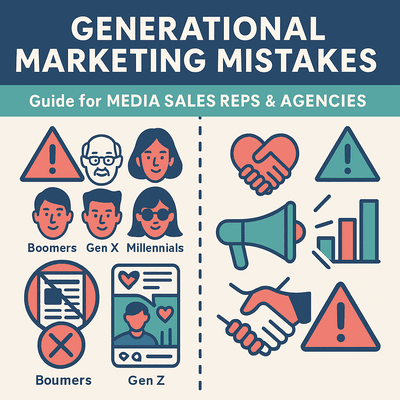
Generational Marketing Mistakes Costing Local Businesses: A Guide for Media Sales Reps and Agencies
Local businesses are making costly generational marketing mistakes by relying on oversimplified stereotypes, with Harvard Business Review research showing that generational boundaries are often fuzzy, yet widely used labels create ineffective campaigns that alienate existing customers while failing to attract new demographics. Common errors include creating separate campaigns for each generation that fragment brand identity, using outdated assumptions about preferences, and focusing on channels over meaningful messaging. Successful businesses are shifting toward authentic multi-generational messaging that emphasizes universal values like trust and community connection while adapting communication styles for different platforms rather than creating different brand personalities. Media sales reps can add value by helping clients conduct cross-generational audience analysis, develop platform-appropriate messaging frameworks, and measure success through both generational response tracking and overall brand health metrics.

B2B Lead Generation Made Simple: How to Connect with the Right Customers
Let’s talk about B2B lead generation. It sounds complicated, right? But it’s really just a fancy way of saying, “finding the right people for your business and getting them interested in what you offer.” The challenge? Not all businesses are the same. What works for a software company probably won’t work for a manufacturing firm. That’s why you need a different approach for different industries.
.png)
What Google Zero Means for Agencies, Advertisers, and Local Media Sellers
AI Overviews are accelerating a shift toward “Google Zero,” where users get answers without clicking through, weakening the value of organic search traffic. That is a warning sign for publishers and marketers, but also an opening for local media sellers and agencies to reposition radio, TV, cable, print, outdoor, and digital as channels that build top-of-mind awareness, trust, and demand before a search ever happens. In a world where discoverability is increasingly controlled by answer engines, advertisers may place greater value on media that makes brands known, remembered, and hard to ignore.

What’s Holding You Back in Your Leadership Development?
As a leader, it’s important to constantly work on your development and growth in order to effectively guide and inspire your team. However, there may be certain behaviors or habits that are holding you back from reaching your full potential and you might not even be aware of it. Here are few common things that can hinder your leadership development:

TV and the Competition
Most media have recovered as well as could be expected since the start of the pandemic, despite significant losses of ad spending and shifts in people’s media use. TV was able to benefit from its ubiquitous position, as viewers, including young adults, planted themselves in front of their TVs for news and entertainment to fill their additional time at home. Eventually, digital media benefited significantly (and still is), as well as many retailers from
.png)
What the FTC’s Pricing Crackdown Means for Radio, TV, Print, Digital and Outdoor
The FTC’s March 13 warning letters to 97 dealership groups signal that auto advertising is entering a period of sharper scrutiny, especially around price transparency, mandatory fees, financing conditions and vehicle availability. For local media sellers and ad agencies, this is not just a compliance issue but a business issue, because misleading offers can undermine campaign performance across radio, TV, print, digital and outdoor by eroding consumer trust. The opportunity for media professionals is to help dealers create cleaner, more consistent and more credible messaging that improves both legal defensibility and sales effectiveness.

Mastering Chess Strategy and Sales Conversations: How Openings Win in Both Games
In the seventh grade, I learned to play chess. When I got to high school, I came across a book called Bobby Fischer Teaches Chess, and decided to study it. It was unusual. It gave you a chess puzzle to solve. To see how you did, you had to turn the book upside down to read Fischer’s notes and recommended strategy. I played all summer and got better and better, beating my freshman peers easily. The seniors, however, were able to beat any and all freshmen.
.png)
Retail’s Next AI Leap: When the Bot Stops Chatting—and Starts Deciding
Retailers are moving beyond AI chatbots and beginning to deploy “agentic” AI that can take real actions, from marketing execution to customer-service workflows. As that shift accelerates, many are discovering that broad, general-purpose large language models often struggle with retail’s rule-heavy, SKU-level realities—where accuracy matters more than eloquence. Smaller, domain-specific language models trained on a retailer’s own verified data can deliver more reliable outputs for tasks like product content, attribute extraction, recommendations, and support automation. For local media sellers and agencies, the opportunity is to help advertisers turn first-party product and customer data into scalable, compliant creative and smoother campaign workflows—positioning themselves as operational partners, not just inventory vendors.